+1 (301) 610-3555
 +1 (301) 610-3555
 +91 70161 27118



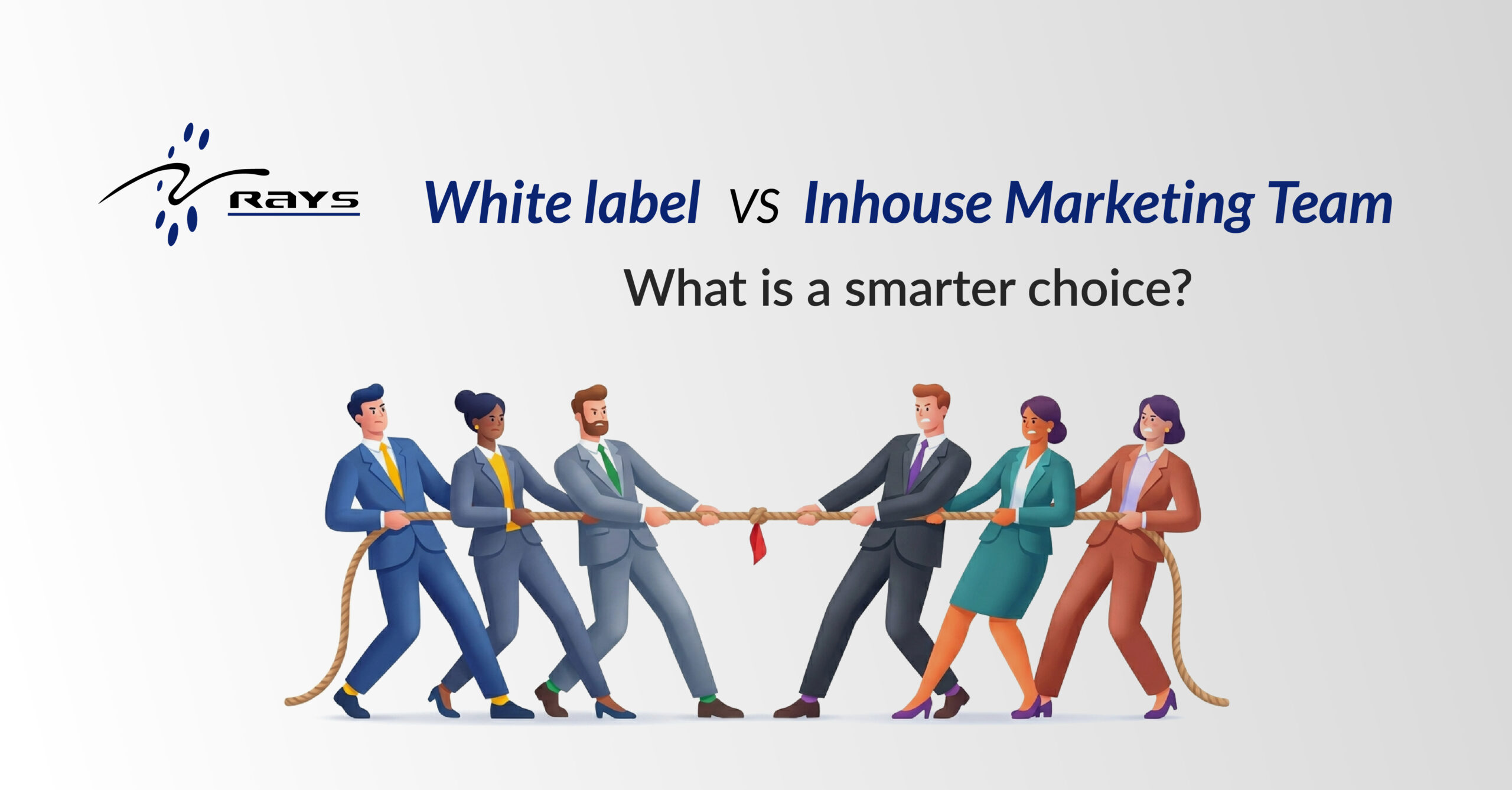
Running a digital marketing agency in the United Kingdom has never been more expensive. Average digital marketing executive salaries now reach £29,000–£37,000 per year nationally, rising to over £43,000 at the median in London (Robert Half, 2026). Add the government’s increased employer National Insurance rate now fixed
at 15% for the 2026/27 tax year alongside mandatory pension contributions and the National Living Wage rising to £12.71 per hour from April 2026, and the true cost of building an in-house team is higher than it has ever been.
At the same time, 73% of UK employers still report difficulty finding skilled talent (ManpowerGroup Talent Shortage Survey, 2026), with the average time-to-hire sitting at eight weeks. For agencies trying to grow, that is eight weeks of lost capacity every time a team member leaves.
One question has moved squarely to the top of every UK agency owner’s agenda: should we hire in-house, or partner with a white label digital marketing provider? This article gives you a comprehensive, data-driven comparison of both models so you can make the right decision for your agency in 2026.
Understanding the Two Models
What Is an In-House Marketing Team?
An in-house team consists of employees on your payroll who work exclusively for your agency. They are subject to UK employment law and represent a fixed, recurring cost regardless of your client workload. Building in-house means committing to salaries, employer NI at 15%, pension contributions, holiday pay, sick pay, recruitment fees, software licences, and ongoing management overhead.
What Is a White Label Digital Marketing Agency?
A white label digital marketing agency is a third-party provider that delivers services entirely under your brand. Your clients see only your agency’s name on every report, deliverable, and communication. You sell at your chosen margin; the white label partner handles all fulfilment. Services typically available on a white label basis include: SEO, PPC management, paid social, content writing, email marketing, web development, and performance analytics reporting.
UK Market Context 2026
The UK digital marketing sector remains one of the fastest-growing in Europe, yet the skills shortage is acute and persistent. According to Amazon’s digital skills research, there is only one qualified candidate available for every seven digital vacancies in the UK a ratio that shows no sign of improving in the near term.
Meanwhile, the April 2026 employer NI increase to 15% (up from 13.8% in 2024/25) has added material cost to every hire. For a £35,000 salary, that represents an additional £4,140 in employer NI alone before pension, recruitment, or tooling costs are factored in.
The True Cost in 2026: What UK Agencies Actually
Pay
The headline salary figure tells only part of the cost story. Here is the fully-loaded annual cost of a mid-level in-house marketing hire in the UK for 2026 compared with a white label arrangement for equivalent output:
| Cost Component | In-House (UK, 2026) | White Label Partner |
|---|---|---|
| Base Salary / Fee | £29,000–£43,000/yr (London avg £36,365) | £600–£2,800/mo (flexible) |
| Employer NI (15% from Apr 2026) | ~£3,600–£5,700/yr on top of salary | None |
| Holiday & Sick Pay | 28 days min + statutory sick | None |
| Pension Contributions | Minimum 3% employer | None |
| Recruitment Cost | £3,500–£9,000 per hire (avg 8 wk process) | None |
| Training & Development | £800–£2,500/yr per person | Included in service |
| Software & Tool Licences | £1,500–£5,000/yr | Included in service |
| Management Overhead | Significant — HR, reviews, compliance | Minimal |
| National Living Wage Floor | £12.71/hr from April 2026 | N/A |
| Scalability | Slow — avg 8 weeks to hire | Instant — days not weeks |
| Minimum Commitment | Typically 1–3 months' notice period | Often monthly rolling |
The Real 2026 Numbers
When you account for the 15% employer NI, pension contributions, 28 days’ statutory holiday, recruitment fees, training, and tooling, a single mid-level in-house marketing hire in the UK now costs between £45,000 and £75,000 per year in total employment cost before management time or the risk of a costly bad hire.
A comparable white label arrangement for the same scope of work typically costs £1,200 to £3,500 per month, with no long-term commitment, no employment law risk, and the ability to scale capacity up or down within days.
Honest Pros and Cons for UK Agencies in 2026
In-House Marketing Team
Advantages
- Deep brand knowledge and cultural alignment
- Direct control over quality and process
- Real-time collaboration and communication
- Builds long-term institutional knowledge
- Can develop unique, proprietary methodologies
Disadvantages
- High fixed costs regardless of client workload
- Average 8-week hiring process in the UK (2026)
- 15% employer NI adds £3,600 - £5,700 per hire/yr
- Skills gaps when clients demand specialist work
- Redundancy and notice costs when downsizing
White Label Digital Marketing Agency
Advantages
- Low, flexible cost pay only for what you use
- Instant access to specialists (SEO, PPC, dev)
- Scale up or down within days, not months
- No recruitment, HR, or employment law risk
- Frees owners to focus on sales and growth
Disadvantages
- Less direct control over day-to-day delivery
- Requires robust briefing and QA processes
- Partner quality varies due diligence is critical
- Risk of over-reliance on a single provider
- Time zone differences may slow urgent requests
Scalability: The Decisive Factor for Growing UK Agencies
For agencies in growth mode, scalability is arguably the single most important factor in this decision. Consider a scenario familiar to almost every agency owner: you win a significant new client in Q3, requiring SEO, content, and PPC services but your existing team is already operating at full capacity.
With an in-house model, your options are limited. You can overwork your current staff (risking burnout and quality decline), rush a hire (which, at an average of eight weeks in 2026, still leaves a capacity gap plus £3,500 – £9,000 in recruitment costs), or turn away the client entirely.
With a white label partner, you expand your scope of work with your provider typically within 48 – 72 hours. When the project ends or client needs change, you scale back down just as quickly: no redundancy payments, no notice periods, no difficult conversations.
Scalability: 2026 Reality Check
In-House: Average UK time-to-hire is now 8 weeks (4Front Recruitment, 2026). Redundancy costs apply. Fixed headcount creates a hard ceiling on agency growth.
White Label: New service lines activated in days. Capacity scales with your client roster, not your headcount. 70% of UK Talent Specialists cite finding candidates with the right skills as their top challenge white label eliminates this problem entirely (Totaljobs, 2026).
Service Quality: Can White Label Match In-House Standards?
Quality is the concern most UK agency owners raise first when considering white label partnerships and it is a legitimate one. The honest answer: it depends entirely on who you choose as your partner and how well you manage the relationship.
The best white label digital marketing providers employ dedicated specialists technical SEO strategists, PPC managers, content writers, and developers who work across multiple client accounts and therefore develop deep, current expertise that a generalist in-house hire cannot replicate at the same price point.
The key to consistent quality is establishing clear processes from day one:
- Provide detailed briefs with clear objectives, tone of voice, and brand guidelines
- Establish regular reporting cadences weekly updates, monthly performance
reviews - Request white-labelled dashboards and reports branded with your agency name
- Define clear escalation paths for time-sensitive client requests
- Start with a pilot project or single service line before committing fully
When managed well, clients consistently report that white label work is indistinguishable from in-house delivery. In specialist areas such as technical SEO or advanced PPC optimisation, the white label provider often delivers superior results because they are true specialists, not generalists wearing multiple hats.
Which Model Is Right for Your UK Agency in 2026?
There is no single correct answer the right model depends on your agency’s size, stage, and strategic ambitions. Use this framework:
| Your Situation | Recommended Model | Reason |
|---|---|---|
| Early-stage agency (1–5 staff) | White Label | Minimise fixed costs, maximise agility and service breadth. |
| Growing agency winning new service verticals | White Label | Launch new services in days without costly specialist hires. |
| Established agency, stable high-volume clients | Hybrid (Both) | Core team for strategy; white label for execution at scale. |
| Agency with unique proprietary methodology | In-House | Protect IP and maintain full control over delivery process. |
| Enterprise agency with 50+ staff | In-House + WL | In-house for strategy and client relationships; WL for overflow. |
| Agency facing seasonal demand spikes | White Label | Scale capacity up/down without permanent payroll pressure. |
What to Look for in a White Label Partner
If you decide to explore white label outsourcing, choosing the right partner is the most critical decision you will make. Here is what UK agencies should evaluate carefully:
Proven Track Record and Verifiable Case Studies
Ask for anonymised case studies relevant to your client industries. A credible white label provider will have documented, measurable outcomes rankings improvements, conversion lifts, cost-per-acquisition reductions not just testimonials.White-Labelled Reporting and Dashboards
Your partner must provide reports you can present directly to clients under your own brand. Custom branded PDFs, white-labelled analytics dashboards, and regular performance summaries are non-negotiable. Opaque or delayed reporting is an immediate red flag.- Dedicated Account Management
Avoid providers who treat you as a helpdesk ticket. The best white label agencies assign a dedicated account manager who understands your agency’s clients, voice, and communication preferences and is reachable when you need them. - UK Market and GDPR Familiarity
For UK agency clients, your white label partner must demonstrate genuine familiarity with the UK market local search behaviour, British consumer language, GDPR compliance, and sector-specific regulations. This knowledge directly impacts the quality of client results. - Flexible, Transparent Pricing
Avoid long-term lock-ins early in a new partnership. Look for rolling monthly arrangements with clear pricing tiers that allow you to scale services up or down as your client roster evolves. Pricing transparency is a strong indicator of an honest, trustworthy partner.
Spotlight: What a Strong White Label Partner Looks Like in Practice
When evaluating white label digital marketing providers, RaysTechServ an India-based digital marketing agency with extensive experience serving UK and international agency clients is a strong example of what best-in-class fulfilment looks like in practice. Their model is built specifically around the needs of agencies: full white-label delivery, no client-facing branding, and results-focused account management.
| Service Area | What RaysTechServ Delivers for UK Agencies |
|---|---|
| SEO & Technical Audits | Comprehensive on-page, off-page and technical SEO — white-labelled under your agency brand with full audit reports. |
| PPC Management | Google Ads, Meta Ads and LinkedIn campaigns with transparent performance reporting and budget management. |
| Social Media Management | Content calendars, scheduling, community management and monthly analytics reports in British English. |
| Content Marketing | Blog posts, landing page copy, email sequences and long-form content written in UK English — SEO-optimised. |
| Web Design & Development | WordPress, Shopify and custom builds — fully white-labelled, no provider branding, handed over as your work. |
| Analytics & Reporting | White-labelled dashboards and monthly performance reports ready to present directly to your clients. |
The India–UK Advantage in 2026
A common concern UK agencies raise about offshore white label providers is
time zone compatibility. India Standard Time (IST) is 4.5 hours ahead of GMT which in practice means your white label team is already well into their working day when you open your inbox each morning. Briefs sent at close of business UK time are frequently actioned and ready for review by your next working day.
Combined with significantly lower operational costs without any compromise on output quality this time zone dynamic works strongly in favour of UK agencies. RaysTechServ specifically provides UK facing account managers, British English content as standard, GDPR-aware data handling, and flexible rolling monthly contracts with no long-term lock-in.In a market where the 15% employer NI rate and an 8-week average hiring timeline are genuine constraints on growth, a well-managed India-based white label partner removes both obstacles simultaneously.
The Hybrid Model: The Best of Both Worlds
For many established UK agencies, the smartest answer in 2026 is not an either/or choice. A hybrid model a small core in-house team for strategy, client relationships, and brand-sensitive work, supplemented by a trusted white label partner for specialist execution offers the greatest combination of quality control and commercial flexibility.
This structure lets you compete on service breadth with agencies twice your size, while maintaining the agility and cost efficiency of a boutique operation. You avoid the fixed-cost ceiling that prevents smaller agencies from scaling, without sacrificing the client intimacy that differentiates you from the larger networks.
Hybrid Model: How It Works in Practice
Core in-house team (2–5 people): Account management, strategy, new business development, client communication and relationship management.
White label partner (RaysTechServ): SEO execution, PPC management, content writing, web development, social media management, and performance
reporting.
Result: An agency that presents as a full-service operation with the strategic
depth of a boutique and the execution capacity of a much larger team at a fraction of the fixed overhead cost.
Conclusion: Make the Decision That Serves Your Growth in 2026
The white label versus in-house debate does not have a universal answer but for the majority of UK digital agencies operating in 2026, the economics are unambiguous. With employer NI locked at 15%, average hiring timelines of eight weeks, and total employment costs running to £45,000–£75,000 per mid-level hire, building an in-house team for every service line your clients demand is simply not viable for most agenciesbelow 20 staff.
The smartest UK agencies in 2026 are those that invest in strong client relationships and strategic thinking in-house while trusting proven white label partners to deliver the specialist execution that drives measurable results. That combination of strategic intimacy and execution excellence is what wins and retains clients in a competitive market.
If you are ready to scale your agency without scaling your headcount, a trusted white label partner is the most direct path to sustainable, profitable growth.
Ready to Scale Your UK Agency Without the Overhead?
RaysTechServ partners with UK digital agencies to deliver fully white-labelled SEO, PPC, social media, content and web development all under your brand, with no long-term lock-in and pricing designed for agency margins.
Visit: www.raystechserv.com