/
/





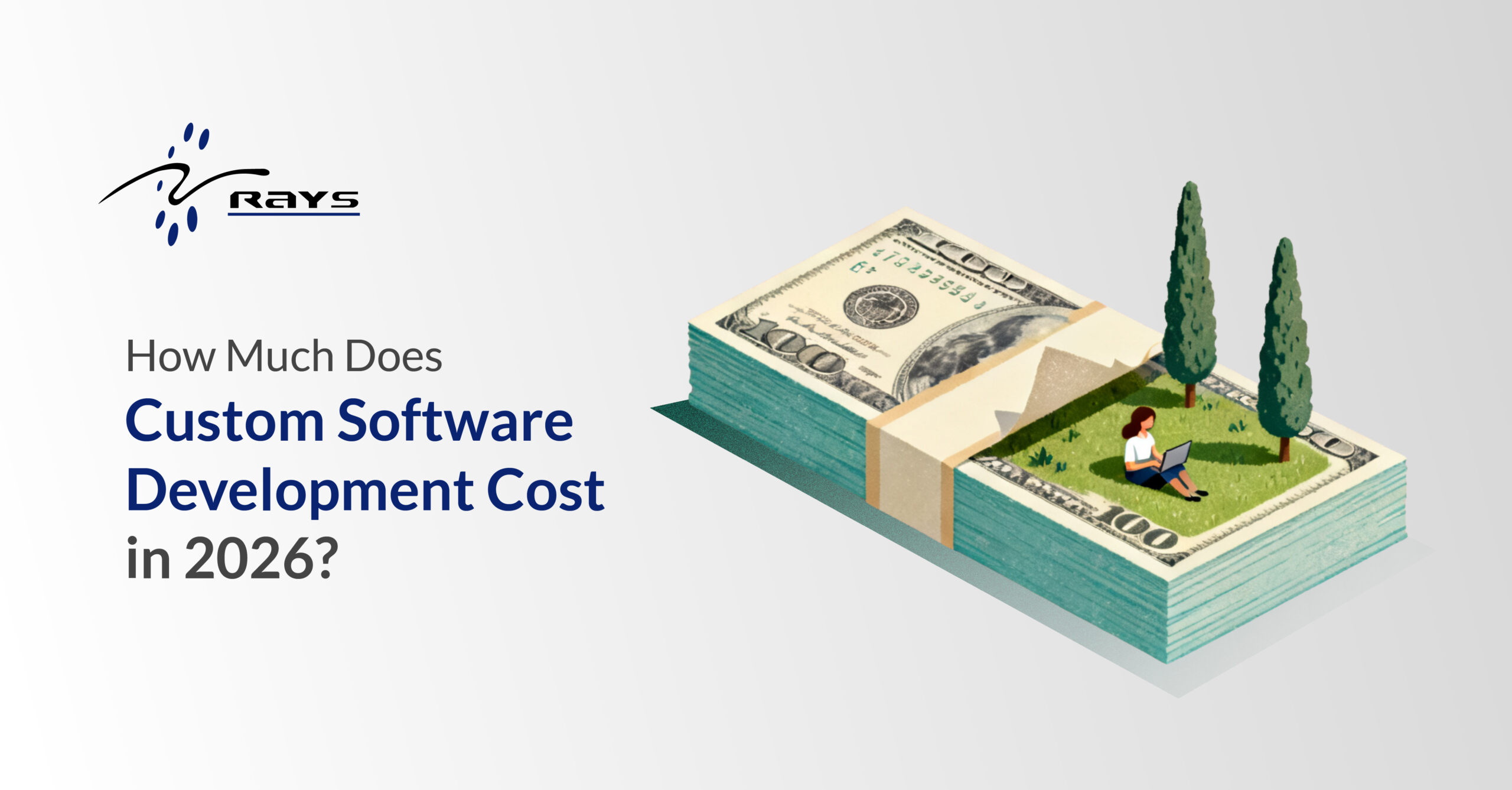
“How much does custom software development cost?” is one of the most searched questions in the technology industry and one of the least honestly answered.
Search results are flooded with vague ranges like “$10,000 to $500,000” that leave business owners no better informed than before they started. The truth is, cost depends on a specific combination of factors and understanding those factors is just as important as knowing the numbers themselves.
This guide gives you real, sourced 2026 pricing data covering project types, hourly rates by region, cost breakdowns by development phase, hidden costs that sink budgets, and a clear framework for estimating what your specific project will cost. Whether you are a startup founder evaluating your first build, an SMB modernising a legacy system, or an enterprise planning a large scale platform, this guide has the numbers you need.
Custom software development costs range from $10,000 for a simple MVP to $500,000+ for enterprise-grade platforms.
The average mid-size project costs $50,000–$150,000, with an average delivery timeline of 13 months (Clutch, 2026).
The single biggest lever on cost: where your development team is based.
US/UK developers charge $100–$250/hr; India-based developers charge $20–$50/hr for comparable output.
Custom Software vs Off-the-Shelf: Which Is Right for You?
Before diving into costs, it is worth addressing the foundational question: do you actually need custom software, or would an off-the-shelf solution like Salesforce, Shopify, or QuickBooks serve your needs?
| Factor | Custom Software | Off-the-Shelf |
|---|---|---|
| Upfront Cost | High ($30k–$500k+) | Low ($0–$500/mo) |
| Long-Term Cost | Lower (no per-seat fees) | High (scales with users) |
| Fit to Your Process | Perfect — built for you | Compromise — built for everyone |
| Time to Launch | Months | Days to weeks |
| Scalability | Unlimited — you own it | Limited by vendor roadmap |
| Competitive Edge | High — proprietary advantage | Low — competitors use same tool |
| Best For | Complex, unique workflows | Standard processes, fast start |
Custom software makes the most sense when your workflows are genuinely unique, when off-the-shelf tools create friction that costs more than the software would, or when you are building a product to sell. According to McKinsey research, top economic performers are more likely to build proprietary software assets because those assets become durable competitive advantages that competitors cannot simply buy.
Custom Software Development Cost by Project Type (2026)
Cost is primarily driven by scope and complexity. Here are 2026 benchmarks by project category, based on data compiled from GoodFirms, Clutch, and Keyhole Software’s survey of 200+ verified projects:
| Project Type | Cost Range (2026) | Timeline | Typical Scope |
|---|---|---|---|
| Simple MVP / Internal Tool | $10,000–$60,000 | 1–4 months | Basic CRUD, limited users, simple UI |
| Small Business Web Application | $30,000–$100,000 | 3–6 months | User auth, dashboards, integrations |
| Mid-Size SaaS Platform | $75,000–$200,000 | 6–12 months | Multi-tenant, billing, admin portal |
| Mobile App (iOS + Android) | $50,000–$150,000 | 4–10 months | Cross-platform, APIs, push notifications |
| Custom CRM / ERP | $50,000–$300,000+ | 6–18 months | Complex workflows, reporting, compliance |
| AI-Powered Application | $80,000–$400,000+ | 6–18 months | ML models, data pipelines, LLM integration |
| Enterprise Platform | $200,000–$500,000+ | 12–24 months | High availability, security, scale, compliance |
The Average Project Reality
According to Clutch’s 2026 pricing data, the average custom software project costs $132,480 and takes 13 months to deliver not the 3 – 4 months most clients initially expect. This timeline has real implications for cash flow and business planning. Budget not just for development, but for the 13 months before your software starts generating returns.
Hourly Rates by Region: 2026 Global Comparison
The single biggest cost variable is where your development team is located. A 4x to 5x difference in hourly rates between the US and India means the same 2,000 – hour project can cost $300,000 onshore or $60,000 – $100,000 offshore for comparable technical output when the engagement is structured correctly.
| Region | Hourly Range | Avg Rate | Key Considerations |
|---|---|---|---|
| United States / Canada | $120–$250/hr | $150–$200/hr | Highest quality oversight, max time zone alignment, premium cost |
| United Kingdom | $100–$180/hr | $130–$160/hr | Strong talent, EU compliance familiarity, high cost |
| Western Europe | $80–$150/hr | $100–$130/hr | Strong skills, approaching US pricing |
| Eastern Europe | $40–$80/hr | $57/hr avg | 35–40% below US; strong technical talent pools |
| Latin America | $35–$75/hr | $61/hr avg | Nearshore for US; real-time collaboration advantage |
| India | $20–$50/hr | $30–$45/hr | 4–5x cheaper than US; massive talent pool; 6M+ developers |
| Southeast Asia | $20–$45/hr | $28/hr avg | Cost-competitive; growing but variable quality |
The India Advantage in 2026
India hosts nearly 6 million software developers the world’s largest talent pool with strong English proficiency, established tech infrastructure, and hourly rates of $20-$50/hr (vs $120-$250/hr in the US).
For a 2,000-hour project: a US team costs $240,000-$500,000. An equivalent India-based team costs $40,000-$100,000 a saving of 60-80% for comparable technical output. Rays TechServ’s Ahmedabad-based development teams bring 20+ years of experience serving US and UK clients across healthcare, fintech, SaaS, and enterprise sectors with ISO-certified quality processes and named developer accountability.
Cost Breakdown by Development Phase
Custom software development is not a single cost it is a series of phases, each with its own budget requirement. Understanding the breakdown prevents the most common budgeting mistake: planning only for coding while ignoring everything around it.
| Phase | % of Budget | Typical Cost | What It Covers |
|---|---|---|---|
| Discovery & Business Analysis | 5–10% | $2,000–$15,000 | Requirements, architecture, roadmap planning |
| UI/UX Design | 10–15% | $5,000–$40,000 | Wireframes, prototypes, design system |
| Frontend Development | 20–30% | $15,000–$80,000 | User interface, responsive design, performance |
| Backend Development | 25–35% | $20,000–$100,000 | APIs, business logic, database, integrations |
| QA & Testing | 10–15% | $8,000–$40,000 | Unit, integration, UAT, performance testing |
| DevOps & Deployment | 5–10% | $5,000–$25,000 | CI/CD, cloud setup, monitoring, launch |
| Project Management | 10–15% | $8,000–$35,000 | Coordination, reporting, stakeholder communication |
Do Not Skip Discovery
Quality development agencies always begin with a discovery phase requirements analysis, technical architecture, and UX wireframes before writing a single line of code.
Discovery typically costs £2,000-£8,000 / $3,000-$15,000 but saves 3-5x that in rework caused by unclear requirements. Be cautious of any agency that skips discovery and quotes immediately it is a reliable warning sign.
The Hidden Costs That Sink Software Budgets
Most cost overruns in software development do not come from the initial development scope they come from costs that never appeared in the original estimate. According to Keyhole Software’s 2026 research of 200+ projects, optimism bias accounts for roughly 40% of timeline and budget failures. Here are the hidden costs you must budget for from day one:
Annual Maintenance & Support
15–25% of your original development cost, per year. Software is not a one-time purchase. Security patches, dependency updates, bug fixes, and compliance changes are ongoing. A $100,000 build requires a $15,000-$25,000/yr maintenance budget.
Cloud Infrastructure & Hosting
AWS, Azure, or GCP costs vary dramatically with traffic. A simple app may cost $50/mo; a high-traffic SaaS platform can reach $5,000-$20,000/mo. Factor in costs for storage, CDN, database instances, and backup systems.
Third-Party Integrations & Licences
Payment gateways (Stripe, PayPal), analytics platforms, email services, and CRM integrations each carry costs. Licensing fees for APIs and SDKs can add $500-$5,000+/mo depending on usage volume.
Training & Change Management
Expensive systems are regularly underutilised because users revert to familiar manual processes. Budget for onboarding, training documentation, and internal champions to drive adoption.
Security & Compliance
GDPR (UK/EU), HIPAA (US healthcare), PCI-DSS (payments), and SOC 2 compliance requirements can add $10,000-$50,000+ to development costs and ongoing audit expenses annually.
Scaling Costs
Infrastructure costs that look manageable at launch can multiply 10x under real user load. Plan for load testing, auto-scaling configuration, and database optimisation before you hit growth ceilings.
Pricing Models: Fixed Price vs Time & Material vs Dedicated Team
How you structure your contract has a significant impact on total cost and risk. There are three dominant engagement models in 2026:
| Model | How It Works | Best For | Advantage | Disadvantage |
|---|---|---|---|---|
| Fixed Price | Agreed scope, fixed budget | Well-defined projects, MVPs | Budget certainty | Inflexible; scope changes are costly |
| Time & Material | Pay hourly for actual work done | Evolving requirements, agile builds | Maximum flexibility | Budget unpredictability |
| Dedicated Team | Monthly retainer for a named team | Long-term products, ongoing development | Deep product knowledge, stable cost | Minimum 3–6 month commitment |
Which Model Does Rays TechServ Recommend?
For first-time builds with a clear scope: Fixed Price gives you budget certainty and clear milestones.
For SaaS products and evolving requirements: Time & Material gives your team the flexibility to iterate based on real user feedback.
For ongoing product development: A Dedicated Team model provides the best value your team builds deep product knowledge over time, reducing onboarding costs and rework cycles on every engagement.
Real Cost Examples: What Does Your Budget Actually Buy?
Abstract numbers are difficult to reason about. Here are real-world examples of what different budgets deliver in 2026, based on an India-based development partner (Rays TechServ rates: $25-$45/hr) versus a US/UK agency ($120-$200/hr):
| Budget (India-based) | What You Get | Timeline | US/UK Equivalent Cost |
|---|---|---|---|
| $15,000–$30,000 | MVP web app, basic user auth, 3–5 core features | 3–4 months | ~$120,000–$200,000 |
| $30,000–$60,000 | SaaS platform with subscription billing, admin portal, 3rd-party APIs | 4–7 months | ~$200,000–$350,000 |
| $60,000–$120,000 | Full mobile app (iOS + Android), backend API, push notifications | 6–10 months | ~$300,000–$500,000 |
| $100,000–$200,000 | Custom ERP or CRM, complex workflows, role-based access, reporting | 9–15 months | $400,000–$700,000+ |
| $150,000–$400,000 | AI-powered enterprise platform, ML models, data pipelines, integrations | 12–20 months | $600,000–$1M+ |
Factors That Push Your Cost Up – Or Down
Factors That Increase Cost
- AI/ML integration specialists add 12-15% premium above standard rates
- Fintech compliance (PCI-DSS, FCA) adds 10–20% to development scope
- Healthcare regulations (HIPAA, NHS Digital) significant compliance overhead
- Native mobile development (separate iOS + Android) vs cross-platform up to
40% more - Real-time features (WebSockets, live dashboards) infrastructure and
complexity premium - Legacy system integration unpredictable complexity; always add 20-30% contingency
Factors That Reduce Cost
- Offshore development team (India) – 60-80% cost reduction vs US/UK rates
- Cross-platform mobile development (React Native, Flutter) 30-40% savings vs native
- Modern tech stacks (React, Node.js, Python) – larger talent pool, faster
development - Clear, well-documented requirements upfront – reduces rework and scope creep significantly
- Agile MVP approach build core features first, validate, then expand
- Reusing open-source components and APIs reduces custom build time substantially
How to Evaluate a Software Development Partner
The partner you choose matters as much as the budget you set. Here is what to look for in 2026:
- Portfolio and case studies: Look for projects in your industry or of similar complexity. Ask for live demos, not just screenshots.
- Discovery process: Any credible agency starts with requirements analysis before quoting. A quote with no discovery is a red flag.
- Named developer accountability: Know who is building your product. Anonymous team structures create accountability gaps.
- IP protection and NDAs: Ensure contracts include IP assignment, source code ownership, and non-disclosure agreements from day one.
- Communication and time zone overlap: Define meeting cadence, reporting format, and escalation paths before signing.
- Post-launch support: Confirm maintenance terms, SLA commitments, and how bugs and updates are handled after go-live.
- ISO certification: Quality-certified development partners (ISO 9001, ISO 27001) offer documented processes and security standards.
Why Rays TechServ for Custom Software Development
20+ years of experience serving US, UK, and global clients across healthcare, fintech, SaaS, real estate, and enterprise sectors.
ISO 9001, ISO 20000, and ISO 27001 certified – documented quality, service, and information security management processes.
Named developer model – you know exactly who is building your product, with direct access and full IP assignment.
India-based rates ($25-$45/hr) with US/UK aligned communication, GDPR-aware practices, and flexible engagement models. Clients include the National Cancer Institute (USA), CTIS, Ogilvy & Mather, Brahma Kumaris, and 50+ businesses across 10+ industries.
ROI: Does Custom Software Development Pay Off?
The most important question is not “how much does it cost?” it is “what return will it generate?” According to Mobisoft’s 2026 analysis of custom software projects, well-scoped custom software delivers 200-500% ROI over three to five years, with break-even typically occurring within 12-24 months.
The ROI comes from multiple sources: eliminating manual processes (labour cost savings), reducing software licensing fees (replacing multiple SaaS subscriptions), improving customer experience (retention and revenue lift), and creating a proprietary competitive asset that competitors cannot replicate.
ROI Reality Check
If your business spends $50,000/yr on SaaS subscriptions that a custom platform would replace a $120,000 custom build breaks even in under 30 months and saves money every year after.
If a manual process costs 20 hours of staff time per week at £25/hr that is £26,000/yr in labour. A £60,000 automation build pays back in under 3 years and compounds in value as your team grows.
If your software does not have a plausible path to positive ROI within 24 months the project needs to be rescoped before it is built.
Conclusion: Budget Smarter, Build Better
Custom software development in 2026 is not cheap but it is also not as expensive as many organisations assume, especially when you engage the right partner. The difference between a $300,000 US agency build and a $60,000 India-based build is not quality it is geography and overhead structure.
The keys to a successful, on budget project are: investing in discovery before a single line of code is written, choosing a partner with named developer accountability and ISO certified processes, budgeting for the full lifecycle (not just development), and starting with an MVP to validate before scaling.
If you are ready to explore what your project will cost with a trusted, experienced development partner, Rays TechServ offers free consultation and scoping for all new enquiries.
Get a Free Custom Software Development Quote
Rays TechServ provides fixed-price and dedicated team engagements for startups, SMBs, and enterprises across the US, UK, and globally. ISO-certified, 20+ years of experience, India-based rates.
Visit: www.raystechserv.com