/
/





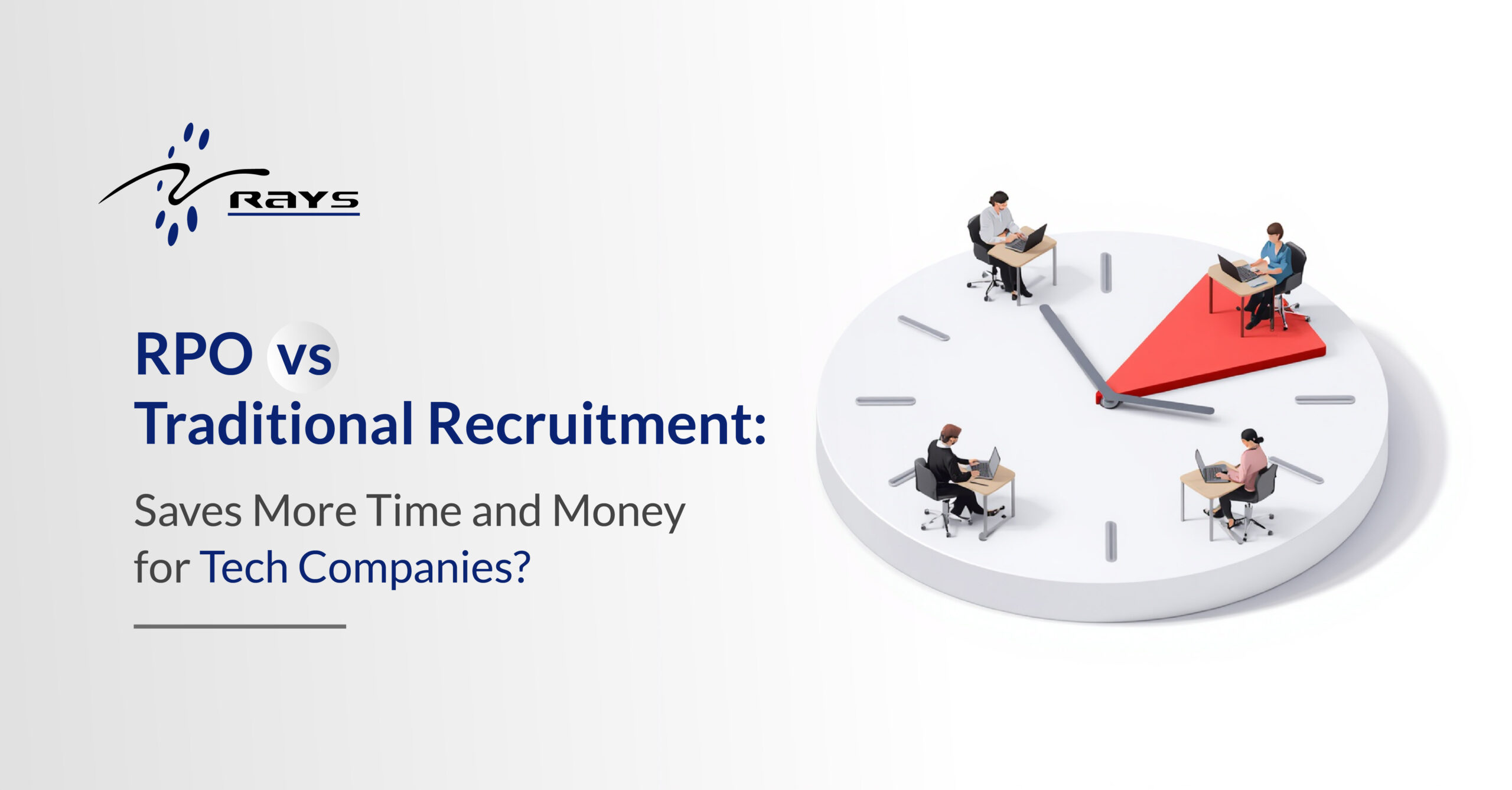
The average tech company pays $18,000 to $30,000 per hire through a traditional recruitment agency in 2026. The same hire through an RPO provider costs $2,000 to $7,000 (Dover, 2026). That gap which compounds dramatically at scale is why the global RPO market is on track to hit $9.5 billion this year, with tech companies driving a significant share of that growth.
But the cost difference alone does not tell the full story. The more important question for your business is which model actually fits your hiring volume, your speed requirements, and the specialist talent you need to find. This guide breaks down the real difference between RPO and traditional recruitment with numbers, not generalities so you can make the right call for your team in 2026.
What Traditional Recruitment Actually Costs You
Traditional recruitment agencies operate on a placement fee model: you pay a percentage of the hired candidate’s first-year salary, typically 15 to 25%, every time they fill a role. For a senior backend engineer at £80,000, that is a £12,000 to £20,000 fee per hire. For a principal architect at $180,000, you are looking at $27,000 to $45,000 per placement.
The fee structure is only part of the true cost. Research consistently shows that companies underestimate the total cost of hiring by 30 to 40% when they ignore the internal time their hiring managers, HR teams, and senior engineers spend reviewing CVs, running interviews, and managing agency relationships (SkillSeek, 2026). Add the productivity loss from a role sitting vacant for 45 to 60 days during a traditional agency search, and the real cost per hire is significantly higher than the placement fee suggests.
Traditional agencies also have a structural incentive problem. They earn their fee when the role is filled not when the hire succeeds. That misalignment matters. A candidate placed quickly who leaves within six months costs you another agency fee on top of the ramp-up time you already lost. Most traditional agencies offer a replacement guarantee, but it rarely covers the full cost of a bad placement.
How RPO vs Traditional Recruitment Compares on Cost and Speed
Recruitment Process Outsourcing (RPO) is a fundamentally different model. Instead of paying per placement, you bring in an external provider who operates as an embedded extension of your HR team owning the recruitment process from sourcing and screening through to offer management and onboarding. The provider works inside your ATS, represents your employer brand, and is measured on long-term outcomes rather than individual placements.
The cost difference at scale is substantial. Companies using RPO reduce time-to-hire by 40% and save 30 to 40% on total recruiting costs compared to traditional agencies (Dover, 2026). The break-even point where RPO becomes more cost-effective than agency fees sits at around 15 to 25 hires per year (Procizo, 2026). If your tech company is making more than that, RPO almost always wins the total cost analysis.
RPO also shifts the quality dynamic. Because your RPO partner is measured on retention and hiring quality rather than speed of placement, they have a direct incentive to get the right person into the role not just any person. In a tech hiring market where a bad engineering hire can cost two to three times the annual salary in lost productivity and rework, that alignment matters enormously.
“Companies using RPO reduce time-to-hire by 40% and save 30 to 40% on recruiting costs. The break-even versus traditional agencies sits at 15 to 25 hires per year.”
Where Traditional Recruitment Still Wins
Traditional recruitment agencies are not obsolete they are simply the right tool for a narrower set of situations than most tech companies currently use them for.
For highly specialised, confidential, or executive-level searches, a specialist traditional agency with deep network access in a specific niche often outperforms an RPO provider. If you need a VP of Engineering with specific domain experience in regulated industries, a specialist headhunter who has spent a decade building relationships in that exact space will access candidates that a generalist RPO process will not reach.
Traditional agencies also remain the right choice for one-off or low-volume hiring where setting up an RPO engagement would cost more than the placements themselves. If you are hiring two or three roles in a year, the operational overhead of a full RPO partnership is hard to justify on cost grounds alone. A targeted agency engagement is faster to activate and requires less internal coordination.
Rays TechServ Provides IT Staffing and RPO for Tech Companies
Rays TechServ Provides IT Staffing and RPO for Tech Companies We help US, UK, and global tech companies scale their engineering teams faster and at lower cost through dedicated IT staffing, RPO partnerships, and startup hiring support. India-based operations. 20+ years of experience. ISO-certified quality.
The Honest Problem With RPO That Most Guides Skip
Here is what the RPO industry does not advertise: a poorly chosen RPO partner can cost you more than a traditional agency ever would in wasted setup time, misaligned processes, and candidates who fit the RPO’s database rather than your actual culture.
The most common RPO failure mode is choosing a partner based on price and scale rather than domain fit. An RPO provider that excels at high-volume e-commerce hiring will struggle to source senior distributed systems engineers or ML infrastructure specialists. Tech hiring requires technical assessment capability, credible employer branding in engineering communities, and recruiters who can hold a meaningful conversation with a candidate about the role. Generic RPO providers frequently fall short on all three.
The second failure mode is rigid contracts. Some RPO providers lock you into fixed monthly fees regardless of hiring volume which means you pay full price during a hiring freeze and scramble for capacity during a surge. Before you sign anything, confirm that your RPO partner can adjust scope and pricing mid-engagement without penalty. Flexibility is not a nice-to-have in tech hiring it is a requirement.
How to Decide: A Simple Framework for Tech Companies
The decision between RPO and traditional recruitment comes down to three variables: your hiring volume, your hiring consistency, and the specialist depth you need in the roles you are filling.
If you are hiring fewer than 15 roles per year and the roles are standard enough that a good agency can fill them from an existing network, traditional recruitment is probably the right answer. The fee is higher per hire, but the operational simplicity and speed of activation outweigh the cost premium at low volumes.
If you are hiring 15 or more roles per year, if your volume fluctuates significantly between quarters, or if your HR team is spending more time managing recruiters than managing people strategy, RPO is almost certainly the more cost-effective model provided you choose a partner with genuine technical hiring capability.
Five signals that your tech company has hit the RPO tipping point:
- Your agency spend exceeds £150,000 or $200,000 per year on placement fees alone.
- Your average time-to-fill for technical roles sits above 45 days.
- Your HR team spends more than 30% of its time managing recruitment admin rather than people strategy.
- You have had two or more agency placements leave within six months in the past year.
- Your hiring volume is growing faster than your internal recruitment capacity can scale.
The Bottom Line
When you weigh up RPO vs traditional recruitment, the right answer is not the same for every tech company.
Traditional agencies win on speed of activation and network access for specialist or executive roles. RPO wins on cost, process consistency, and quality of hire at scale but only when you choose a partner with genuine technical hiring capability and a contract structure that matches your reality.
For most tech companies making more than 15 hires a year, the numbers consistently favour RPO. The £18,000 to £30,000 per-hire agency model made sense when your hiring was occasional. At the pace most tech companies are scaling in 2026, it is one of the most avoidable costs on your P&L.;
If you want a straight assessment of which model makes sense for your specific situation, Rays TechServ offers a free hiring consultation for tech companies. We will give you an honest answer including when the answer is not us.
Scale Your Tech Team Faster and at Lower Cost
Rays TechServ delivers RPO and IT staffing for tech companies across the US, UK, Europe, and UAE. Technical recruiters. Flexible volume-based pricing. ISO-certified. 20+ years of international hiring experience.