/
/





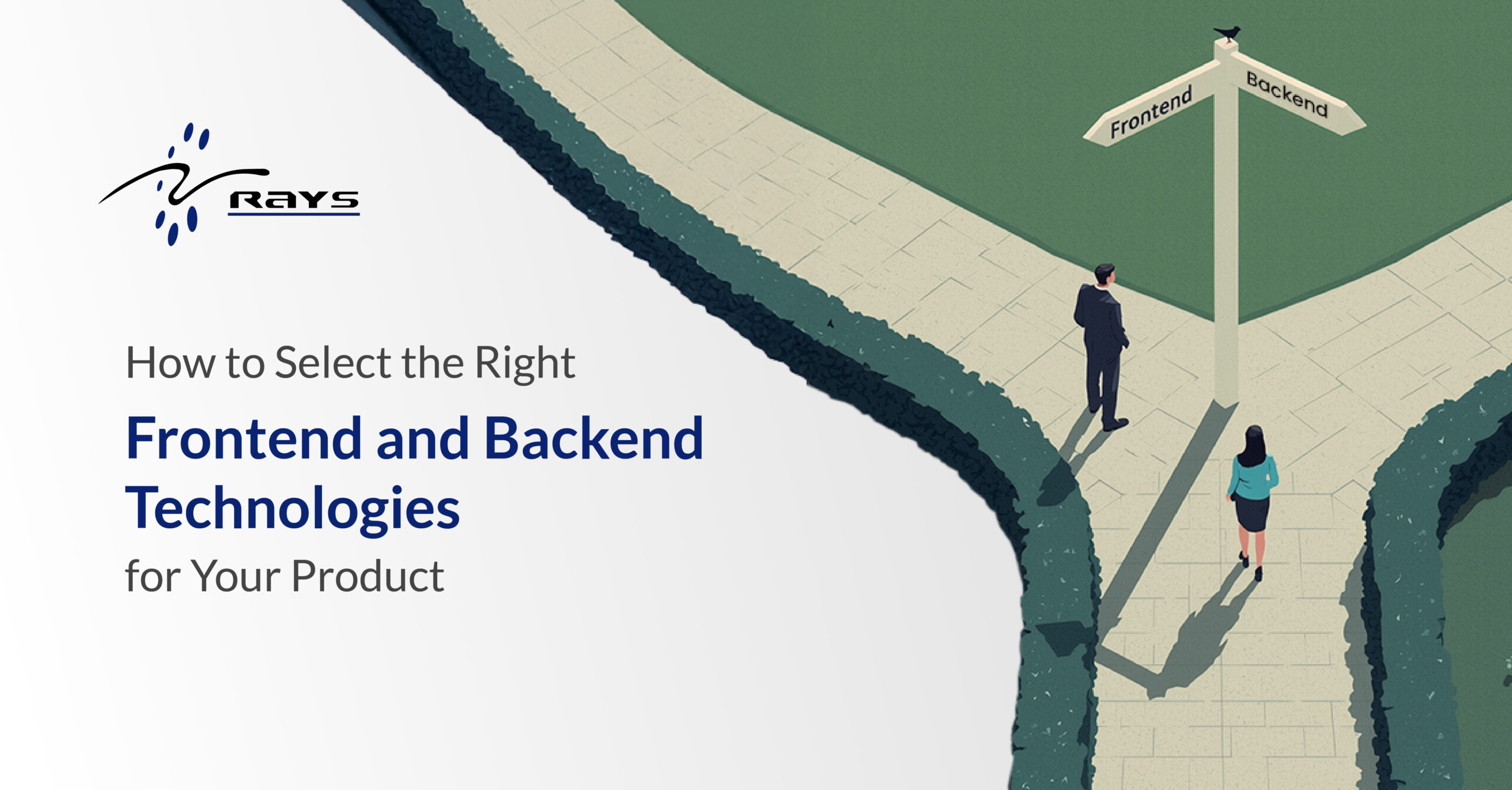
53% of mobile users abandon a site that takes longer than three seconds to load (Google, 2026). That single statistic is a direct consequence of tech stack decisions made before a product was built. The frontend and backend technologies you choose determine how fast your product runs, how quickly your team ships, how much it costs to scale and whether your engineers can find enough help when things go wrong.
This guide gives you a clear, honest framework for making that decision. Not a list of every framework ever written, but the specific questions you need to answer and the logic that connects your answers to the right choice for your product.
Start With Your Product, Not the Framework
The most common and costly tech stack mistake is choosing a framework because it is popular, because a co-founder knows it, or because a blog post called it ‘the future of web development.’ The right tech stack is not the one with the most GitHub stars. It is the one that fits your product’s specific requirements, your team’s existing skills, and the scale you actually need to reach.
Before you evaluate a single framework, answer four questions about your product. Is it content-heavy or interaction-heavy? Does it need real-time features like live chat, notifications, or collaborative editing? Will it need to serve thousands of users or millions? And does your competitive advantage live in the user interface, the data processing layer, or both?
Your answers to those four questions will eliminate the majority of options before you open a single documentation page. What remains is a shortlist you can evaluate seriously, against real criteria, in a fraction of the time.
Frontend Technologies: What the 2026 Market Actually Looks Like
React remains the dominant frontend framework in 2026, used by over 40% of professional developers globally (Stack Overflow Developer Survey, 2026). Its component-based model, vast ecosystem, and backing from Meta make it the lowest-risk choice for most product teams building complex, interactive interfaces. Next.js has become the default React framework for production applications, with built-in server-side rendering, static generation, and edge deployment that addresses the performance limitations that once made React-only SPAs a slower option.
Vue.js is the right choice when your team wants React’s component model with a gentler learning curve and a less opinionated structure. It consistently outperforms React in developer satisfaction surveys and works exceptionally well for customer-facing applications where iteration speed matters more than ecosystem breadth. Angular is the third major option and the right one in a specific context: large enterprise teams where consistency, built-in tooling, and strict TypeScript enforcement outweigh flexibility.
The emerging shift you need to know about in 2026 is the move toward server-first UI architectures. React Server Components, Astro, and similar approaches are reducing the amount of JavaScript shipped to the browser, delivering measurable performance improvements on Core Web Vitals which directly affects your search rankings. If your product is content-heavy or SEO-critical, this shift deserves serious attention in your 2026 stack planning.
Backend Technologies: Matching the Engine to the Load
Node.js continues to dominate backend development for good reason. Its non-blocking, event-driven architecture handles high-concurrency workloads exceptionally well making it the right choice for real-time applications, API-first architectures, and teams who want a single language across frontend and backend. Node.js 22.x introduced native HTTP/3 and QUIC support in 2026, further widening its performance advantage for network-intensive applications.
Python with Django or FastAPI is the backend choice that makes the most sense when your product involves data processing, machine learning integration, or rapid API development. Python’s ecosystem for data science and AI is unmatched if your backend needs to run ML models, process large datasets, or connect to AI pipelines, Python is not just a good choice, it is the obvious one. FastAPI in particular has become the default for new Python API services in 2026, delivering async performance that closes much of the gap with Node.js.
Go is the backend language gaining the most ground in 2026 for high-performance microservices. It compiles to native binary, handles concurrency with goroutines rather than threads, and delivers performance that consistently outperforms Node.js and Python in CPU-intensive workloads. The tradeoff is a smaller web framework ecosystem and a steeper learning curve which means Go makes sense when performance is a hard requirement, not just a preference.
“The backend decision you make in 2026 is a strategic decision not just a technical one. It determines your hiring pool, your infrastructure costs, and your ability to integrate AI into your product over the next three years.”
The Contrarian View: Team Skill Beats Framework Quality
Here is the point that most tech stack guides avoid because it is less exciting than a framework comparison: the best tech stack for your product is almost always the one your team already knows how to build with.
A team that knows Django inside out will ship a production-grade product faster in Django than in a theoretically superior framework they are learning while building. The productivity gap between a team working in its strongest stack and a team learning a new one is typically three to six months of delivery time which is an eternity for a startup validating a market or an enterprise meeting a board deadline.
This does not mean never adopt new technology. It means adopt it deliberately, with a learning period that does not coincide with your most critical delivery milestone. The businesses that build the best products are not the ones chasing the newest framework they are the ones shipping consistently in the stack they command.
The Hidden Cost of Choosing the Wrong Stack
Switching your tech stack mid-build is one of the most expensive decisions a product team can make. It typically costs three to six months of rework, increases team turnover risk, and erases the institutional knowledge your engineers have built around the existing codebase. If your current stack is delivering results, evolve it incrementally rather than replacing it wholesale. The exception is when your architecture has a hard technical ceiling that your product’s growth will hit within 12 months in which case, plan the migration before you hit the wall, not after.
Not Sure Which Stack Is Right for Your Product?
Rays TechServ’s architecture team works with founders and CTOs across the US, UK, and globally to scope the right frontend and backend technologies for each specific product then builds it. India-based rates. ISO-certified. 20+ years of experience.
The Five Questions That Lead You to the Right Stack
Use these five questions as your decision framework. They are the same ones a senior architect would ask at the start of any engagement and the answers consistently narrow the field to two or three credible options rather than twenty.
- What does your product need to do that is unique? If your competitive advantage is in data processing or AI, your backend language is probably Python. If it is in real-time interaction, Node.js. If it is in raw throughput at scale, consider Go.
- Who will build and maintain it? Your team’s strongest language wins against an unfamiliar one almost every time. If you are hiring, check the talent market in your region before committing to a stack.
- What does your scale look like in 18 months? Design for the scale you will reach in 18 months not five years. Over-engineering for hypothetical future scale is one of the most common and expensive startup mistakes.
- Monolith or microservices? Start with a well-structured monolith unless you have strong evidence that your system requires independent scaling of specific components. Microservices add significant operational complexity that small teams consistently underestimate.
- What does your data model look like? Relational data with complex queries points to PostgreSQL. High-write, flexible-schema workloads point to MongoDB or DynamoDB. AI and vector search workloads point to PostgreSQL with pgvector or a dedicated vector database.
The Stack Rays TechServ Recommends for Most Startups and SMBs
For the majority of product teams starting a new build in 2026, the combination of Next.js on the frontend, Node.js or Python FastAPI on the backend, and PostgreSQL as the primary database gives you a mature, well-supported stack with deep talent availability in every market. It handles the vast majority of product requirements without forcing architectural complexity you are not ready to manage. When you need to add AI capabilities, Python’s ecosystem integrates cleanly. When you need to scale, each component scales independently. It is not the most exciting recommendation but it is the one that ships products on time and on budget more consistently than any other combination we see in practice.
The Bottom Line
Selecting the right frontend and backend technologies is not about finding the objectively best framework. It is about finding the best fit for your product, your team, and the scale you are genuinely building toward. The businesses that make this decision well by asking the right questions before they open a documentation page ship faster, spend less on rework, and build products that hold up as they grow.
The businesses that make it badly spend the first six months of a new product fighting an architecture that was chosen for the wrong reasons. That is a recoverable position, but it is an expensive one. Getting this right at the start is significantly cheaper than fixing it later.
If you are at the decision point right now scoping a new product, evaluating a rebuild, or assembling a team to build it Rays TechServ offers a free architecture consultation. We will tell you what we recommend and why, with no obligation to engage further.
Build Your Product With the Right Stack From Day One
Rays TechServ designs and builds custom software for startups, SMBs, and enterprises across the US, UK, Europe, and UAE. From architecture scoping and tech stack selection to full product development with a dedicated named team. ISO-certified. India-based rates of $25 to $45/hr.