/
/





Hiring developers in-house is slower and more expensive than it used to be, and finding senior engineers in AI, cloud and data is harder still. That is why more companies are turning to external partners.
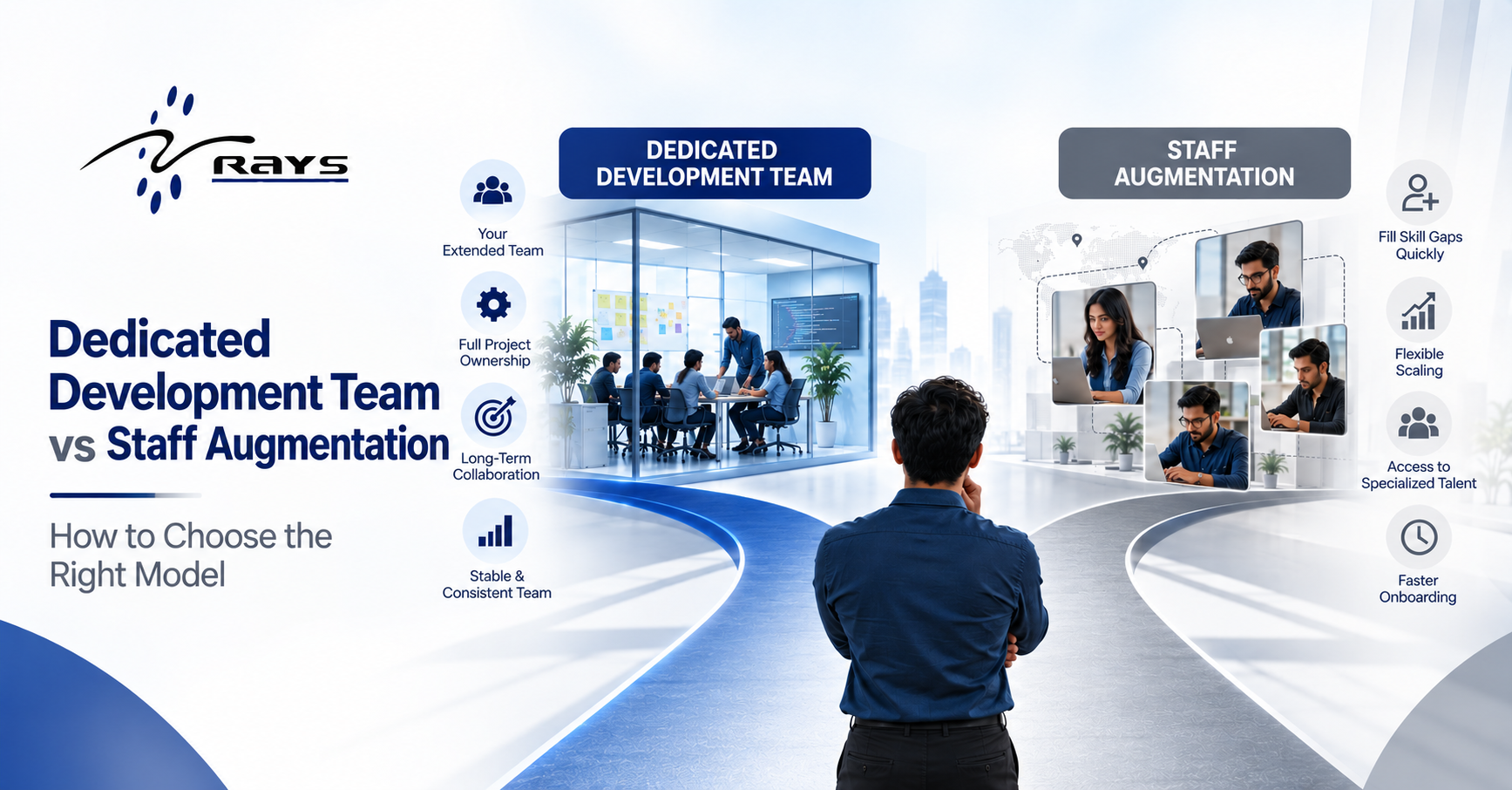
Two models come up most often: a dedicated development team and IT staff augmentation. They sound similar, but they work very differently, and choosing the wrong one can cost you months and budget.
This guide explains both models, compares them side by side, and helps you decide which fits your project.
What Is a Dedicated Development Team?
A dedicated development team is a group of engineers, often with a project manager, QA and designer, who work full-time on your product. The vendor handles hiring, HR, infrastructure and team management, while you set the goals and priorities.
Think of it as an extension of your company that you don’t have to build from scratch.
Typical team members:
- Developers (frontend, backend, mobile)
- QA engineers
- UI/UX designer
- Project manager or tech lead
- DevOps or data engineer, if needed
Best for: long-term products, SaaS platforms, healthcare and fintech systems, and companies without an internal engineering department.
What Is IT Staff Augmentation?
Staff augmentation means adding individual specialists to your existing team. They work under your management, follow your processes and use your tools. You keep full control, and the vendor provides talent and handles payroll and compliance.
Best for: filling a specific skill gap (for example, an MLOps or Angular developer), short-term workload spikes, and companies that already have strong technical leadership.
Dedicated Team vs Staff Augmentation: Side-by-Side Comparison
| Factor | Dedicated Development Team | Staff Augmentation |
|---|---|---|
| Who manages the work | Vendor manages the team day to day; you set direction | You manage everyone directly |
| Best for | Full products, long-term projects | Skill gaps, short-term needs |
| Team structure | Complete team (dev, QA, PM, design) | Individual specialists |
| Your management effort | Low to medium | High |
| Speed to start | Moderate (team is assembled) | Fast (individuals can start quickly) |
| Scalability | Scale the whole team up or down | Add or remove single people easily |
| Control | Shared | Full control |
| Cost model | Monthly fee per team | Monthly or hourly rate per person |
| Accountability | Vendor is accountable for delivery | You are accountable for delivery |
| Risk | Lower, since a full team is in place | Higher if your management is weak |
When Should You Choose a Dedicated Development Team?
A dedicated team is usually the better choice if:
- You are building a new product or platform. You need designers, developers and testers working together from day one.
- You don’t have an in-house tech team. The vendor provides the management layer you are missing.
- The project is long-term (6+ months). Teams build product knowledge over time, which improves quality and speed.
- You want to focus on business, not hiring. The vendor handles recruitment, replacements and HR.
- Compliance matters. In healthcare and fintech, a team that has worked on HIPAA or audit-ready systems reduces risk.
When Should You Choose Staff Augmentation?
Staff augmentation is the better choice if:
- You already have a strong engineering team and only need one or two missing skills.
- You need someone quickly for a deadline or a temporary spike in workload.
- You want full control over tasks, tools and code review.
- The scope is short or uncertain. You can add or remove people without restructuring a team.
- You need niche expertise, such as an AI engineer, cloud architect or cybersecurity specialist, for a defined period.
Cost: Which Model Is Cheaper?
Neither model is always cheaper. It depends on how you count the cost.
- Staff augmentation often has a lower rate per person, but you pay for the management time, tooling and coordination it requires from your side.
- A dedicated team has a higher monthly total, but it includes project management, QA and delivery accountability, so there are fewer hidden costs.
Compare the total cost of delivery, not just the hourly rate. A cheaper developer who needs constant supervision can cost more than a well-managed team.
Common Mistakes to Avoid
- Choosing by price alone. The lowest quote often hides management and rework costs.
- Using staff augmentation without technical leadership. Extra developers without direction slow projects down.
- Not defining scope and success metrics. Agree on deliverables, communication rules and reporting from the start.
- Ignoring security and compliance. Check certifications (such as ISO 27001), data handling and IP ownership before signing.
- Skipping a trial period. Start with a small engagement or pilot before committing long-term.
Quick Decision Guide
Ask yourself these five questions:
- Do I have a technical manager who can lead extra developers? Yes → staff augmentation. No → dedicated team.
- Am I building a full product or filling a gap? Product → dedicated team. Gap → staff augmentation.
- Is the timeline long (6+ months) or short? Long → dedicated team. Short → staff augmentation.
- Do I want full control or delivery accountability from the vendor? Control → staff augmentation. Accountability → dedicated team.
- Will my needs change quickly? Individual changes → staff augmentation. Whole-project scaling → dedicated team.
Some companies also start with staff augmentation and later move to a dedicated team as the project grows. This hybrid path works well for startups.
How Rays TechServ Can Help
Rays TechServ has delivered software and technology talent for more than two decades across healthcare, fintech, education and enterprise clients. Whether you need a full dedicated offshore development center (ODC) or specific engineers through IT staff augmentation, our teams work with clients worldwide.
- Dedicated teams and ODC setup for long-term products
- Staff augmentation for AI, cloud, data and full-stack roles
- ISO-certified processes with a focus on security and compliance
- Flexible engagement: contract, contract-to-hire or team-based
Not sure which model fits? Book a free consultation and we will recommend the right setup for your project.
Frequently Asked Questions
What is the main difference between a dedicated team and staff augmentation?
With a dedicated team, the vendor manages a full team focused on your project. With staff augmentation, individual specialists join your team and you manage them directly.
Which model is better for startups?
Startups without a technical leader usually benefit from a dedicated team. Startups with a CTO and a small team often prefer staff augmentation to fill specific gaps.
Is staff augmentation cheaper than a dedicated team?
The per-person rate is often lower, but total cost depends on how much management, coordination and rework you handle yourself.
Can I switch from staff augmentation to a dedicated team later?
Yes. Many companies start with a few augmented developers and expand into a full dedicated team as the project grows.
How long does it take to start with each model?
Staff augmentation can often start within days to a few weeks. Dedicated teams usually take a little longer because the full team is assembled, but they can be operational within weeks.
How do I make sure my code and data stay secure?
Choose a vendor with recognized security certifications, clear IP ownership terms, NDAs and controlled access to your systems.