/
/





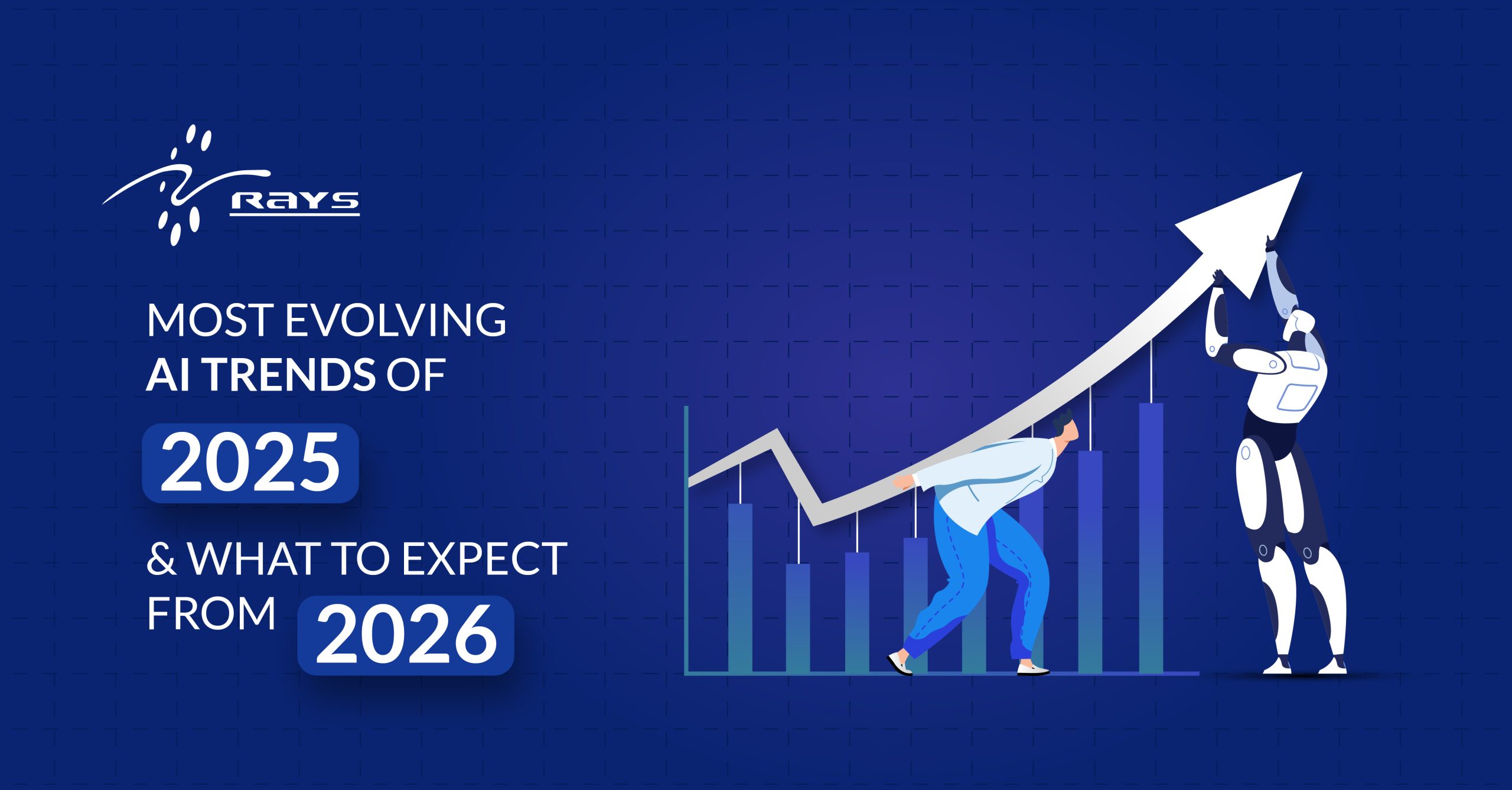
Artificial intelligence is no longer a future concept. It is now shaping business models, products, and operational excellence across industries.
In 2025, we saw rapid transformation in AI adoption. Some trends were evolutionary, others were revolutionary. As we approach 2026, it’s time to look at what took shape this year and where AI is headed next.
This blog explores the top AI trends of 2025 and what businesses, founders, and tech leaders should expect in 2026.
It’s not about hype. It’s about the changes that are already influencing outcomes and will only accelerate.
Generative AI Evolves from Text to Deep ContextZ
What Happened in 2025
Generative AI moved beyond chat and content creation. Models began to understand deeper context, reasoning, and multi-modal inputs combining text, audio, images, and structured data.
This enabled:
- Product design support
- Automated strategy drafts
- Real-time model-assisted decision recommendations
What to Expect in 2026
Generative AI will evolve from assistant to collaborator, actively participating in:
- Design workflows
- Business logic definition
- Predictive problem solving
No longer just a tool, but a default teammate.
AI-First Engineering Workflows
What Happened in 2025
AI became integral to software development. It was not just a helper; it became part of pipelines for:
- Code generation
- Testing automation
- Security scanning
- Performance optimization
Instead of separate AI tools, engineering stacks began embedding AI at their core.
What to Expect in 2026
AI-driven engineering tools will reduce time to production drastically. Common patterns will include:
- Self-optimizing code paths
- Automated release notes and changelogs
- Predictive bug detection before code commits
The Rise of Decision-Making AI
What Happened in 2025
AI shifted from generating suggestions to making operational decisions. Systems began to execute tasks:
- Real-time pricing adjustments
- Intelligent notifications routing
- Supply chain optimization
This moved AI from static analysis to dynamic action.
What to Expect in 2026
Decision AI will become mainstream. Expect:
- Autonomous business logic layers
- Automated service recovery
- Context-aware systems
Edge AI No Longer Optional
What Happened in 2025
Processing at the edge became a necessity for real-time AI, especially in:
- IoT sensors
- Healthcare diagnostics
- Autonomous systems
Cloud lag could no longer meet the needs of instant inference.
What to Expect in 2026
Edge AI will democratize intelligence:
- Local data privacy
- Real-time responsiveness
- Lower compute cost
AI Ethics and Regulation Finally Matter
What Happened in 2025
With wider adoption came greater scrutiny. Governments and enterprises began enforcing AI governance:
- Responsible output tracking
- Bias mitigation
- Outcome traceability
AI without accountability lost trust rapidly.
What to Expect in 2026
AI governance will be a competitive advantage. Expect:
- Standardized ethics frameworks
- AI audit trails
- Adoption scorecards for compliance
Personalized AI Experiences Are Standard
What Happened in 2025
AI moved from generic suggestions to personalized interactions:
- User-centric recommendations
- Role-adaptive dashboards
- Context-aware alerts
This improved engagement and retention.
What to Expect in 2026
AI will anticipate needs proactively. Examples:
- Predictive task suggestions
- Intelligent onboarding flows
- User behavior pattern learning
AI Collaboration Between Humans and Machines
What Happened in 2025
AI began to support human work beyond automation. It acted as:
- Second pair of eyes
- Strategy assistant
- Insight generator
Collaboration became a new workflow norm.
What to Expect in 2026
Expect co-creative AI systems that:
- Understand business context
- Provide context-aware feedback
- Participate in planning, not just execution
Industry-Specific AI Solutions Take Over
What Happened in 2025
Generic AI was helpful, but industry-specific models became the real game changers in:
- Healthcare
- Finance
- Supply chain
- Legal
These models understood language, regulation, and outcomes specific to sectors.
What to Expect in 2026
AI will become hyper-niche:
- Domain experts embedded in models
- Regulation-aware predictive engines
- Sector-specific decision logic
The Developer’s Role Shifts to Orchestrator
What Happened in 2025
AI made basic development tasks easier. Developers began to focus on:
- Architecture
- Integration logic
- AI governance
Routine code was automated away.
What to Expect in 2026
Developers will become designers of systems, not coders of individual functions:
- High-level logic design
- Data pipeline optimization
- AI ethics integration
Predictive Automation Becomes Default
What Happened in 2025
AI learned from historic patterns and automated repetitive workflows.
What to Expect in 2026
AI will predict what needs to be automated next:
- Adaptive workflows
- Behavior-based triggers
- Continuous process improvement
What This Means for Businesses in 2026
AI is no longer an add-on. It is the core of competitive advantage.
To stay ahead:
- Build AI into your product & operations
- Embed ethics and governance from day one
- Use AI to make decisions, not just generate outputs
- Think of AI as a collaborator, not a tool
Where Rays TechServ Fits In
At Rays TechServ, we help businesses:
- Build AI-first platforms
- Integrate predictive decision engines
- Design edge and real-time AI systems
- Staff AI-aware teams that execute fast
Our AI solutions are tailored to your goals, not generic templates.