+1 (301) 610-3555
 +1 (301) 610-3555
 +91 70161 27118



Artificial intelligence is no longer limited to research labs or large technology companies. Businesses across the globe are using AI to automate repetitive tasks, improve customer experiences, analyze data, increase operational efficiency, and build smarter digital products.
But choosing the right programming language is one of the first decisions businesses need to make when starting an AI project.
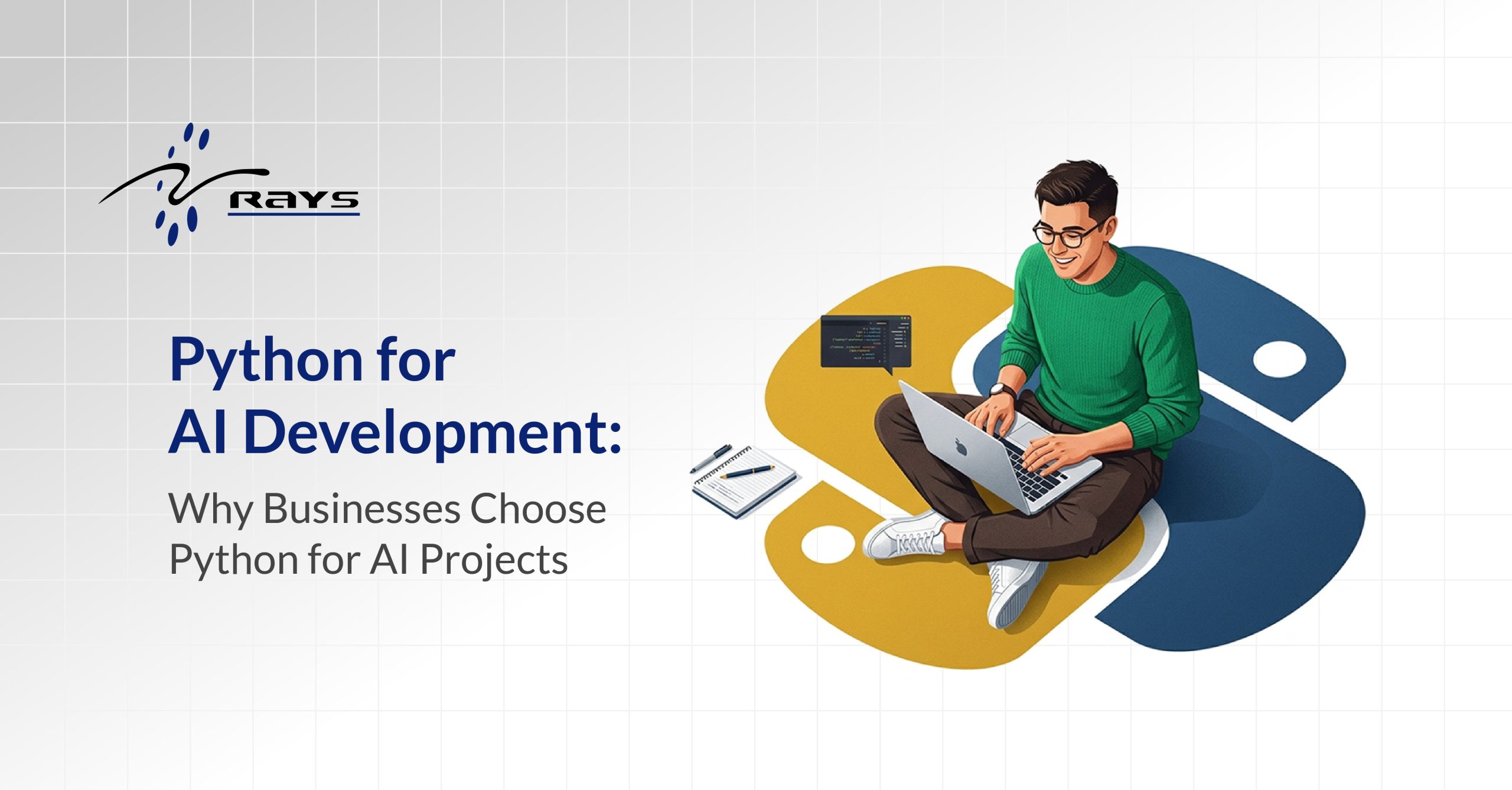
Python has become one of the leading programming languages for artificial intelligence and machine learning development. Its extensive ecosystem, large developer community, flexibility, and compatibility with leading AI frameworks make it a practical choice for businesses building everything from machine learning applications to generative AI and intelligent automation solutions.
For companies planning an AI project, understanding why Python is widely used for AI development can help them choose the right technology stack and development approach.
What Makes Python Popular for AI Development?
Python is widely used for AI because it combines relatively simple syntax with a powerful ecosystem of libraries and frameworks.
Developers can use Python to build and integrate:
- Artificial intelligence applications
- Machine learning models
- Generative AI applications
- AI chatbots
- Recommendation systems
- Predictive analytics platforms
- Natural language processing applications
- Computer vision solutions
- AI-powered SaaS applications
- Business automation systems
- Data analytics platforms
- Intelligent enterprise applications
For businesses, this means development teams can move from experimentation to a working AI solution without having to build every component from scratch.
Why Businesses Choose Python for AI Projects
1. Python Has a Strong AI and Machine Learning Ecosystem
One of Python’s biggest advantages is its extensive collection of AI, machine learning, data science, and automation libraries.
Popular Python technologies include:
- TensorFlow for machine learning and deep learning
- PyTorch for deep learning and AI applications
- Scikit-learn for traditional machine learning
- Pandas for data processing and analysis
- NumPy for numerical computing
- OpenCV for computer vision
- Transformers for natural language processing and generative AI applications
- FastAPI and Flask for building APIs and AI-powered backend applications
This ecosystem gives development teams flexibility when selecting technologies for different AI project requirements.
2. Python Can Speed Up AI Application Development
AI projects often involve experimentation.
A development team may need to test different algorithms, models, APIs, datasets, prompts, or business workflows before identifying the most effective approach.
Python’s straightforward syntax and extensive libraries can simplify this process and help development teams move more efficiently from an idea or proof of concept toward a working application.
For businesses, this can support:
- Faster proof-of-concept development
- Easier model experimentation
- Faster API development
- Reduced development complexity
- Quicker testing of AI concepts
- Faster time to market
This can be particularly useful for startups and organizations that want to validate an AI product before making a larger technology investment.
3. Python Works Well With Machine Learning and Data Science
AI systems depend heavily on data.
Before a machine learning model can produce useful results, businesses often need to collect, clean, transform, analyze, and prepare data.
Python is widely used across this data workflow.
A typical AI development process may look like:
Data Collection → Data Cleaning → Data Analysis → Model Development → Model Training → Testing → API Integration → Deployment → Monitoring
Python can support many of these stages within the same development ecosystem.
This makes it an attractive choice for businesses developing custom machine learning solutions and AI-powered applications.
4. Python Supports Generative AI Development
Generative AI has created another major use case for Python.
Businesses can use Python to develop applications that work with large language models and other generative AI technologies.
Examples include:
- AI chatbots
- AI assistants
- Document analysis systems
- AI content workflows
- Knowledge-base assistants
- Retrieval-augmented generation applications
- AI search applications
- Customer support automation
- Internal business assistants
- AI-powered SaaS products
Python can also connect AI models with existing business applications through APIs.
For example, an AI assistant could be connected to a CRM, knowledge base, customer support platform, or internal database.
This allows organizations to move beyond experimenting with AI and incorporate intelligent capabilities into their existing workflows.
Python vs Other Programming Languages for AI Development
Python is not the only programming language used for artificial intelligence.
Depending on the project, businesses may also use JavaScript, Java, C++, C#, Go, and other technologies.
However, Python is particularly attractive for projects involving machine learning, data science, generative AI, and rapid experimentation.
| Requirement | Python | Other Languages |
|---|---|---|
| Machine learning | Excellent | Depends on language |
| Data science | Excellent | Varies |
| Generative AI | Excellent | Depends on framework |
| AI prototyping | Excellent | Varies |
| Data processing | Excellent | Varies |
| API development | Excellent | Depends on framework |
| Developer ecosystem | Very large | Varies |
| AI libraries | Extensive | Varies |
The right technology ultimately depends on the project’s business requirements, existing infrastructure, scalability needs, security considerations, performance expectations, and development goals.
What Can Businesses Build With Python and AI?
Python can be used to develop a wide range of AI-powered business solutions.
AI Chatbots and Virtual Assistants
Businesses can develop AI-powered chatbots that answer customer questions, provide product information, assist employees, or automate support workflows.
Predictive Analytics
Machine learning models can analyze historical data to identify patterns and generate predictions.
Potential applications include:
- Sales forecasting
- Demand forecasting
- Customer churn prediction
- Risk analysis
- Fraud detection
- Inventory forecasting
Recommendation Systems
AI-powered recommendation engines can analyze user behavior and recommend products, services, content, or actions.
This can be particularly useful for ecommerce, SaaS, media, and online marketplaces.
Computer Vision
Python can support computer vision applications across industries such as healthcare, manufacturing, retail, logistics, and security.
Examples include:
- Image classification
- Object detection
- Document processing
- Quality inspection
- Facial recognition
- Medical image analysis
Natural Language Processing
Businesses can use Python-based NLP solutions to process and understand human language.
Applications include:
- Sentiment analysis
- Document classification
- Text extraction
- Customer feedback analysis
- Intelligent search
- Automated document processing
AI-Powered SaaS Applications
Python can also be used as part of the backend architecture for AI-powered SaaS products.
For example, a SaaS platform could use Python for:
- AI model integration
- Data processing
- Recommendation engines
- Predictive analytics
- Automation workflows
- AI APIs
This makes Python relevant for startups building new AI products as well as established organizations adding AI capabilities to existing software.
Python AI Development Across Different Industries
AI is not limited to technology companies. Businesses across the globe and across industries are exploring AI to improve efficiency, make better decisions, reduce repetitive work, and create better customer experiences.
Healthcare
Python can be used to develop:
- Predictive healthcare applications
- Medical data analysis
- Patient-support applications
- Healthcare chatbots
- Medical image analysis
- Healthcare automation
Finance and Fintech
Financial businesses can use Python for:
- Fraud detection
- Risk analysis
- Financial forecasting
- Algorithmic systems
- Customer analytics
- Document processing
Retail and Ecommerce
Retail businesses can use AI for:
- Product recommendations
- Demand forecasting
- Customer segmentation
- Personalized marketing
- Inventory prediction
- Customer service automation
Real Estate
AI-powered Python applications can support:
- Property recommendation systems
- Lead scoring
- Market analysis
- Price prediction
- Customer support
- Real estate data analysis
Education
Educational organizations can use AI for:
- Personalized learning
- Student analytics
- Automated assessments
- AI tutors
- Recommendation systems
- Administrative automation
Python AI Development for Businesses Across the Globe
Businesses across the globe are evaluating AI not simply as a new technology, but as a way to solve specific operational and customer-facing challenges.
Before starting an AI project, organizations should consider questions such as:
- What business problem should AI solve?
- Which AI model or technology is appropriate?
- How will AI integrate with existing software?
- How will business data be protected?
- How much will AI development cost?
- How will the solution scale?
- How will the AI application be monitored after launch?
A professional AI software development company can help businesses evaluate these requirements before development begins.
For organizations considering AI development, Python can provide a flexible foundation for building and integrating AI solutions while allowing the technology stack to evolve as the project grows.
Python AI Development vs Building an AI Solution From Scratch
Businesses sometimes assume that AI development means creating a machine learning model completely from the ground up.
That is not always necessary.
A modern AI application may combine:
Python + Existing AI Models + APIs + Business Data + Cloud Infrastructure + Custom Software
For example, a company could develop a customer support AI system that connects a Python backend with an existing large language model, company knowledge base, CRM, and customer support platform.
This approach can often be more practical than building a large AI model from scratch.
The best architecture depends on factors such as:
- Business requirements
- Data availability
- Security requirements
- Expected user volume
- AI model requirements
- Integration requirements
- Budget
- Scalability
How Much Does Python AI Development Cost?
The cost of a Python AI project varies significantly depending on its complexity.
A simple AI-powered application may require considerably less development work than an enterprise AI platform involving custom machine learning models, multiple integrations, large datasets, and advanced security requirements.
Factors that influence AI software development cost include:
- Project complexity
- Number of features
- AI model requirements
- Data preparation
- API integrations
- Cloud infrastructure
- UI/UX requirements
- Security requirements
- Testing
- Deployment
- Ongoing maintenance
For this reason, businesses should define the expected business outcome and technical requirements before estimating the total project cost.
Why Work With an AI Development Company?
Choosing the right development partner can be as important as choosing the programming language.
An experienced AI development team can help with:
- AI strategy
- AI solution architecture
- Python development
- Machine learning development
- Generative AI development
- AI API integration
- Data engineering
- Cloud deployment
- AI testing
- Application security
- Ongoing maintenance
Instead of selecting technology first and figuring out the business case later, businesses can start with the problem they want to solve and then select the appropriate AI architecture.
Why Choose Rays TechServ for Python AI Development?
Rays TechServ helps businesses transform software ideas into scalable digital solutions using modern technologies.
Our development capabilities can support businesses looking for:
- Python AI development
- Machine learning development
- Generative AI development
- Custom AI software development
- AI application development
- AI integration
- SaaS development
- Cloud and DevOps
- Custom software development
- Dedicated development teams
Whether you are a startup looking to validate an AI product or an established organization looking to integrate AI into an existing application, the right development approach depends on your business objectives, technical requirements, and long-term growth plans.
Talk to the Rays TechServ team about your AI software development requirements and explore how Python can be used to build a practical, scalable AI solution.
Frequently Asked Questions
Is Python good for AI development?
Yes. Python is widely used for artificial intelligence, machine learning, data science, natural language processing, computer vision, and generative AI applications because of its extensive libraries and development ecosystem.
Why is Python used for machine learning?
Python provides access to widely used machine learning libraries and frameworks such as Scikit-learn, TensorFlow, and PyTorch. It also works well with data-processing and other AI development tools.
Can Python be used to build generative AI applications?
Yes. Python can be used to integrate large language models and other generative AI technologies into chatbots, business applications, SaaS platforms, automation workflows, and enterprise software.
What can businesses build with Python and AI?
Businesses can use Python to develop AI chatbots, recommendation systems, predictive analytics applications, computer vision solutions, natural language processing applications, intelligent automation systems, and AI-powered SaaS products.
Is Python suitable for enterprise AI development?
Python can be suitable for enterprise AI applications when it is used as part of an appropriate architecture that addresses scalability, security, performance, integration, and infrastructure requirements.
How much does Python AI development cost?
Python AI development costs depend on the complexity of the application, AI model requirements, integrations, data requirements, infrastructure, security, testing, and overall development scope.
Should my business use Python for an AI project?
Python can be an excellent choice for many AI projects, but the right technology depends on your application’s requirements, existing technology stack, performance expectations, integrations, security needs, and long-term roadmap.
Final Thoughts
Python has become one of the most practical technologies for businesses exploring artificial intelligence, machine learning, generative AI, and intelligent automation.
Its extensive ecosystem makes it possible to build everything from machine learning models and predictive analytics systems to AI chatbots, intelligent SaaS applications, and enterprise AI solutions.
For businesses across the globe, the bigger opportunity is not simply choosing Python. It is identifying where AI can create measurable business value and then building the right technology around that opportunity.
If you are planning an AI project, Rays TechServ can help you evaluate the technology, architecture, development approach, and integration requirements needed to turn your AI idea into a scalable software solution.